

Thai Websites Banner

   The 76 provinces of Thailand : Historical, cultural and religious background - Tourist attractions.

Main Directory | Culture | Business | Real Estate | Media | Travel | Health | Food | Entertainment | Hotels | Industry | Consumer Goods | Articles & Photos | About Us

none none none
none Hotel Accommodation :
Bangkok | Pattaya | Phuket | Koh Samui | Chiang Mai | Krabi | Hua Hin
none
none none none


Central Region of Thailand
Central Thailand
Northern Region of Thailand
Northern Thailand
Northeastern Region of Thailand (Isaan)
Northeastern Thailand
(Isaan)
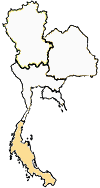
Southern Region of Thailand
Southern Thailand

1. Phetchaburi
2. Ratchaburi
3. Samutsakhon
4. Nonthaburi
5. Nakhonpathom
6. Bangkok
[Rattanakosin 1,
Rattanakosin 2,
Outside Rattanakosin]
7. Samutprakan
8. Samutsongkhram
9. Pathumthani
10. Kanchanaburi
11. Suphanburi
12. Ayutthaya
13. Nakhonnayok
14. Angthong
15. Chainat
16. Lopburi
17. Saraburi
18. Singburi
19. Sakaeo
20. Prachinburi
21. Chachoengsao
Eastern Thailand :
22. Chonburi
23. Rayong
24. Chanthaburi
25. Trat

1. Uthai Thani
2. Nakhon Sawan
3. Phetchabun
4. Phichit
5. Kamphaeng Phet
6. Tak
7. Sukhothai
8. Phitsanulok
9. Uttaradit
10. Phrae
11. Lampang
12. Lamphun
13. Chiang Mai
14. Mae Hong Son
15. Chiang Rai
16. Phayao
17. Nan



1. Nakhon Ratchasima
2. Buriram
3. Surin
4. Si Sa Ket
5. Ubon Ratchathani
6. Amnat Charoen
7. Yasothon
8. Roi Et
9. Mahasarakham
10. Khon Kaen
11. Chaiyaphum
12. Loei
13. Nong Bualumphu
14. Udon Thani
15. Kalasin
16. Mukdahan
17. Sakon Nakhon
18. Nakhon Phanom
19. Nong Khai


1. Prachuap Khirikhan
2. Chumphon
3. Ranong
4. Surat Thani
5. Phangnga
6. Phuket
7. Nakhon Srithammarat
8. Krabi
9. Phattalung
10. Satun
11. Songkla
12. Pattani
13. Yala
14. Narathiwat
15. Trang


Central Region :

Mainly flat and fertile due to the the large Chao Phraya River. This is the main rice-growing area of Thailand.  Geographically, the Central Region extends from rugged western mountains bordering Myanmar (Burma) to the northeast plateau to the east; northwards to Nakhon Sawan where the Ping, Wang, Nan and Yom rivers unite to form the Chao Phraya River (River of Kings) which flows southwards to dissect Bangkok before entering the Gulf of Thailand; and southwards to Prachuap Khirikhan where Thailand is compressed to its narrowest point, some 60 kilometres wide between western mountains and the Thai Gulf.

The Chao Phraya River largely irrigates the Central Plain, one of the world's major rice and fruit-growing areas, and sustains an intricate network of canals that irrigate bountiful orchards and market gardens; host vibrant floating markets; and support a unique, waterborne way of life. The Central Region is extremely rich in historical sites. These include Nakhon Pathom, Kanchanburi, Bang Pa-In, Ayutthaya, Saraburi, Lopburi and most important of all, Bangkok, Thailand's capital and major point of entry.

Northern Region :

Bordered by Myanmar and Laos, characterised by forested mountains - lower extremities of Himalayan foothills - and fertile river valleys, northern Thailand encompasses part of the fabled Golden Triangle. Diverse elements, including crisp mountain scenary, exotic hill tribes, forests worked by elephants, colourful festivals, invigorating cool season weather, ancient cities, exquisite northern Thai and Burmese-style temples, and friendly people contribute to northern Thailand's enduring charm.

The most visited and the must see places for visitors to the region are : Chiang Mai and surrounding areas (including Chiang Rai) for an obligatory visit at least to Doi Suthep, the marvellous looking and well located temple outside the city of Chiang Mai. The less visited but easily reachable historical city of Lamphun can easily be visited from Chiang Mai on a day trip (or even a half-day trip).

Time can also be spent at the numerable handicrafts outlets around Chiang Mai.  Most tour operators will bring visitors to handicrafts shops on a half-day tour. But remember the tour guides, taxi drivers or anyone who brings you near a shop, will all need some commission (that is how it works here!), so it will be included in the price you pay. If you just a bit independent and have some time, get a card from the shop operators, and try to go on your own later (the shop may be even mostly empty at that time). You should get at least 20% discount on items sold.

Visiting hill tribes in the north is appealing to some, disgusting to others. In any case, two and three day trekking around Chiang Mai will (besided the visits to the hill tribes) offer good nature scenery and exercise. Or go with the flow, and take a half day tour, having some elephant riding, riding in a buffalo card, rafting etc. A one day trip up Doi Inthanon (leaving from Chiang Mai) is also a worthwhile nature experience.

Sukhothai should not be missed on a visit to the North. It is located like in the middle between Bangkok and Chiang Mai. Sukhothai itself houses few good hotels, so most visitors stay for the night in Phitsanulok and visit the famous Buddha image of Phra Buddha Chinnarat there.

Northeastern Region (Isaan) :

A high, semi-arid plateau used mainly for cattle and growing crops such as rice and maize. This is the poorest region of Thailand mainly due to some bad droughts in the past.

Known by Thais as Isaan (prounced ee-san) , the sprawling Northeast Plateau is bordered to the north and east by the Mekong River and Laos, and to the south largely by Kampuchea (Cambodia). The Northeast is a distinctive region thanks to topography of lovely forested mountains and national parks and rolling farmland, as well as, to its colourful inhabitants, who speak their own melodious dialect, have a delicious highly spiced cuisine, and a hospitable, vibrant folk culture; and because of archaeologically significant excavations and shrines - such as Ban Chiang where the world's oldest Bronze Age civilization flourished some 3,600 years ago; and venerable prasart hin (stone castle) temples, legacy of Isaan's former importance to the Angkor-centered Khmer empire.

Isaan is arguably the least developed region of Thailand, farming being the occupation of a large proportion of its inhabitants. Lots and lots of Isaan people come to Bangkok to earn a living, and you can really see in Bangkok. They usually speak their own dialect, and being fluent in Thai language will not always help you to understand them. Be sure that most of the taxi drivers, street vendors on Bangkok streets originate from Isaan, and we do not want to speak about all the girls working in the nightlife entertainment scene.

So if you want to see basic rural life, head to Isaan and try to visit some of the smaller villages. Northeastern Thailand does have some urban centers though like Khon Kaen , Udon Thani, Ubon Ratchasima, and Nakhon Ratchasima. While these are important towns, there size is not much compared to the Bangkok metropolis. While most of Isaan is off the track for tourists, we recommend surely to visit the Khmer restored ruins at Phimai (Nakhon Ratchasima), and Phanom Rung. The best way to do this is to travel straight from Bangkok's Northeastern Bus Terminal to Phimai (it will take about 5-6 hours). If you start early, you may be able to visit the ruins at Phimai the same day. Next day try to find an excursion tour to Phanom Rung from Phimai (some guesthouses offer it). It should cost about 1,500-2,000 baht per car. You can visit Phanom Rung, come back to Phimai, and let yourself (and your luggge) be dropped on the way to Nakhon Ratchasima, from where you can take a bus back to Bangkok.
So you are actually able to do all this in two days, although we recommend to enjoy the local scenery and take some more time. Close to Nakhon Ratchasima you could visit Dan Kwian if you are interested in the local colorful ceramics.

Udon Thani and Nong Khai are visited by people on their way to Laos. If you do happen to get to these towns, do not neglect to cross the Friendship bridge and at least visit Laos' capital of Vientiane. The visa (at the border) will cost you 30 US$. From there, basic transport (tuktuk are taxi) can be found into Vientiane, a 30-40 minutes drive. There are quite a few attractions in Vientiane, worth a visit, so we recommend at least two full days of stay. Be aware that health facilities are pretty poor in Laos.

Southern Region :

Hilly and mountainous, covered mainly in rain forests. The land is rich in mineral deposits. This area also receives the most annual rainfall.

Lush tropical islands, dazzling palm-fringed beaches, coral reefs teeming with colourful marine life, picturesque fishing villages with distinctive handpainted boats, remote national parks, forested mountains, waterfalls, historic cities, ubiquitous rubber estates, scenic wildlife sanctuaries, the juxtaposition of temples and mosques clearly define the region's visual appeal. Geographically, southern Thailand extends through the Kra Isthmus from Chumphon, 460 kilometres south of Bangkok, to the Thai-Malaysian border, and is bordered in the east by the Gulf of Thailand, to the west by the Indian Ocean.

The south of Thailand obviously cover a large longitudinal area. Most famous however are the many tourist beach and island resorts. Most famous and probably already overdeveloped is the island of Phuket. The provinces of Phang-Nga and Krabi also house many attractive hotels and resorts. What Thai people are certainly good at is building beautiful, attractive accommodation, still at an affordable price. So visitors have a lot of high quality rooms to choose from.

Koh Samui also has become a very popular destination with its many scenic beaches. It is off the coast of Surat Thani province. Flights to the island are quite frequent with Bangkok Airways, which charges a little higher than usual airfares though (compared to fares with other airlines to other destinations) to get to your destination. The mentioned islands almost invariable offer diving courses and facilities, and you can find a lot of offers to join a diving course or tour. You can find a lot of diving operators at here

Concept and website design by G.V., Bangkok