
Wat Suthat Thepwararam, Bangkok.
Video of Wat Suthat Thepwararam at bottom of this page.
See Location Map
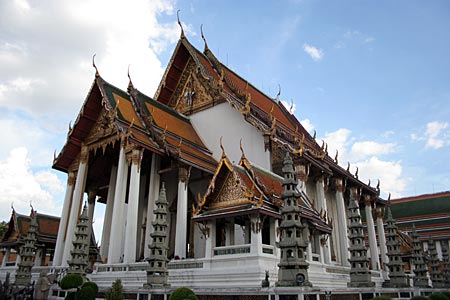
Viharn at Wat Suthat Thepwararam.
Wat Suthat Thepwararam was built during the first three reigns of the Chakri Dynasty and took 40 years to complete (1807-1847). It is one of the four royal wats of the first class (Ratcha-Voramaha-Vihan) in Bangkok, and is directly patronized by the ruling monarch.
At the time of groundbreaking in 1807, the Brahmin monument knows as Sao Ching Cha (Giant Swing) was already present adjacent to the building site.
The name of the wat, given during the fourth reign, refers to the City of the God Indra in the Tavatimsa Heaven. Though obviously a Buddhist temple, Wat Suthat presents links to Hindu cosmology, and two Hindru shrines are located in its vicinity, one just opposite the streets across the main entrance to Wat Suthat.
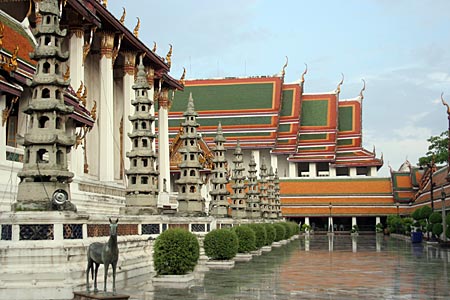
Courtyard around the Viharn, notice the Chinese-style Pagodas on the left.
There are two main buildings at Wat Suthat Thepwararam, the Viharn (Vihan, Wihan, Wiharn, Vihara) and the Ubosoth (Ordination Hall).
The viharn was constructed first around its large residing Buddha Image, Phra Sri Sakyamuni. The Buddha image originates from the Sukhothai Kingdom and goes back to the time of King Phaya Lithai, the fifth king of Sukhothai (around 1361 A.D.). The Viharn was built in the style of Ayutthaya, with a typical (slightly) curved base. You will be surprised to learn that the foundation of this use building consists of teakwood and gravel, not stone or rock. The murals in the viharn detail the previous 28 lives of the Buddha. Mural paintings are common around the inner temple walls in Thailand, and often only the 10 last lives (or Jatakas) will be represented. Also the supporting columns, doors and windows show Buddhism related paintings. Reportedly the murals were renovated between 1982 and 1985, but we were somewhat taken aback by the new degradation of their quality (although the pictures we took may suggest otherwise). Water seeping into the walls from below probably are a persistent problem.
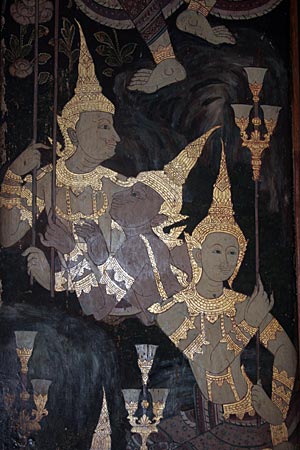
Mural Painting, Viharn, Wat Suthat
At the back of Phra Sri Sakyamuni, is an historically interesting large bas-relief. It shows Dvaravati Buddhist art, was originally made of limestone, but is not lacquered and gold-leafed.
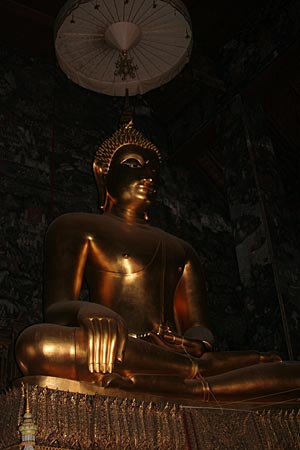
The main Buddha Image at Wat Suthat's Viharn : Phra Sri Sakyamuni.
Walking around the Viharn, there are a lot of interesting features to observe.
There are many magnificently carved and guilted door panels. Each teakwood panel is eighteen feet high.
On the terrace below the viharn's higher level are a total of 28 Chinese-styled pagodas. They refer to the 28 lives of the Buddha described in the mural paintings.
Around the viharn courtyard and temple complex there are many statues of Chinese origins. They include lions, warriors, celestial beings, horsed and wagons. You will notice similar Chinese sculptures at other temple. While obviously works of art, and having value by themselves, they were used as ballast on trading boats, coming back from China to Thailand.
The large gallery around the viharn, has 156 sitting Buddhas in meditation pose. Very few are gold-leafed, and there is not much variation in their appearance.
You should have a look at the gable and pediment of the viharn's entrance. There you will notice the god Indra mounted on his three-headed elephant Erawan.
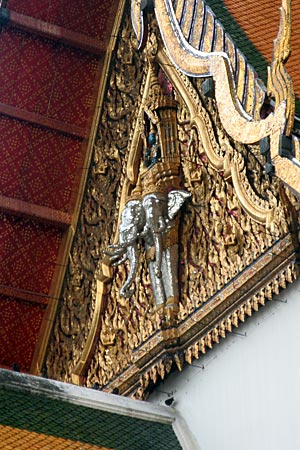
Gable of the Viharn's entrance, showing Indra mounted on his three-headed elephant Erawan.
The Ubosoth at Wat Suthat was built during the reign of Rama III. It is the largest Ubosoth in Bangkok. Sixty-eight columns support the structure, which is built in Ayutthaya style (curved base, like a boat). The Western and Eastern facing gables and pediments of the Ubosoth show Phra Chan (Moon God) and Phra Athit (Sun God) respectively. As most Ubosoths the Ubosoth at Wat Suthat faces East, the direction the Buddha was facing when reaching enlightenment. Therefore also the Buddha Image inside face East (the rising sun).
The Ubosoth houses the Phra Tri Lokachet as its main Buddha Image. It was also cast during the third reign. Unusual is a smaller Buddha image in front of the main image, surrounded by a large gathering of prominent disciples.
Mural paintings are on the inner walls of the Ubosoth. While painted during the Rattanakosin era, they also show European influence. The murals depict the life of the Buddha.
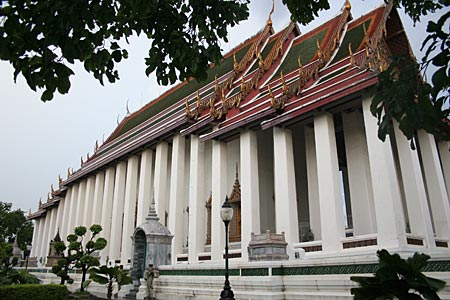
The huge Ubosoth at Wat Suthat.
View Bangkok Temples and More in a larger map