

Tourism Statistics Thailand 2000-2023
Last update this page : Januari 2024.
See graph of quarterly arrivals updated at bottom of page, updated till last quarter of 2023.
Latest :
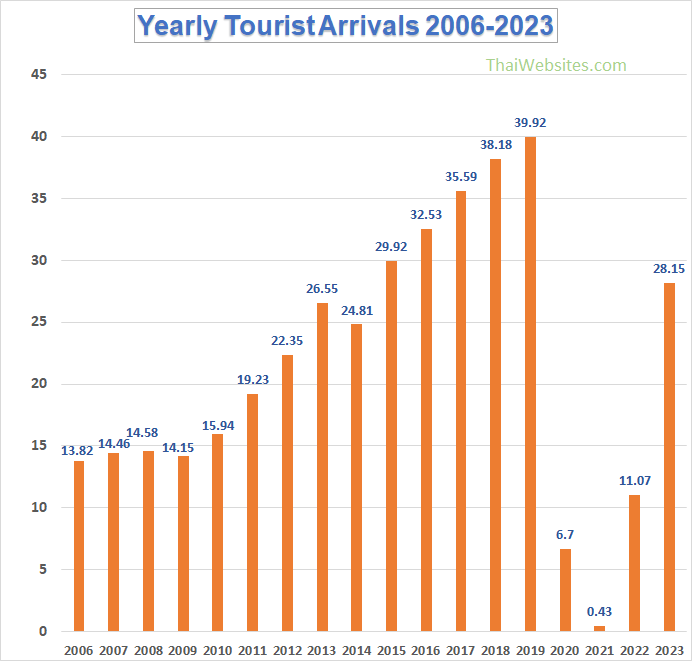
Thailand has restarted its tourism industry for real in the middle of 2022, which showed arrivals of 11,153,026 people by the end of that year. Expectations were very high for 2023. Arrivals were steadily above 2 million visitors each month of the year and even passed the three million mark in December 2023. A total of 28,150,016 visitors arrived. This was an increase of 152.4% over the previous year. In the last year before Covid (2019) there were 39,916,251 visitors, so the present number is still 29.5% lower.
Despite this renewed interest in Thailand (despite geopolitical and financial crises abroad) was splendid. Nevertheless, the Thai government was not fully impressed. The revenue from tourism seems to be needed, and various measures were taken to promote the country for foreign tourists. Mainly it has become easier to get visas and allowed length of stay for citizens of many countries has been extended.
See quarterly arrivals at the bottom of this page. Arrivals in the last quarter of 2023 surpassed 8 million visitors.
The top 5 of countries whose inhabitants visited Thailand in 2023 (between brackets arrivals in 2019, and % change) :
1. Malaysia : 4,626,422 (4,274,458 ; + 8.2 %) : lots of day trips from the country bordering Thailand.
2. China : 3,524,095 (11,138,658) ;: - 68.4 %)
3.
South Korea : 1,660,042 (1,880,465 ; -11.7 %)
4. India
: 1,628,542 (1,961,069 ; -17 %)
5. Russia : 1,482,611 (1,481,837 ; +0.0005 %)
Europe : 5,962,234 (6,531,220 ; -8.7%)
Notes : China is clearly lagging other countries. We suspect Chinese people are traveling less in general, maybe because of the local economic situation. There was also a shooting incident in Bangkok, where a Chinese visitor was killed in a shopping mall, but we do not think this can have been a major factor. Anyway, visa are now easier for Chinese (and other) people to obtain. When reading local newspapers and listening to local news, Thailand is swamped by Russian visitors. In effect, there are about exactly the same number of visitors as before the pandemic (so relatively speaking...). European tourists have resumed visiting more than Asian tourists on average.
Tourist Arrivals last few Years before the Covid-19 Pandemic :
The number of tourists visiting Thailand increased from 35.35 million in 2017 to 38.28 million in 2018 and then 39.92 million in 2019. The increase in visitors from 2018 to 2019 was limited to 4.24 %, which actually was less than Thai authorities expected. The ever rising number of tourists arriving came to an abrupt end from March 2020 onwards. 2020 saw only a total of 6,702,396 tourists, almost all arriving in the first three months of the year. From March 2020 to end August 2020 no tourists were allowed in. Thereafter in the last three months of 2020 a total of 10,822 tourists arrived under very special stringent conditions.
Lots of people in the hospitality sector lost their jobs and/or are in dire straits. As 2020, 2021 was a dismal year with hardly any visitors arriving, but we had the 'opening' of the country as from 1 November 2021. This appears to have been an audacious move, since at the time of the announcement of the initiative, a new wave of Covid-19 (the delta strain) was hitting the country hard, much more so than during the initial infections during 2020. But it likely needed to be done, since lots of people (and a lot of smaller SME companies) have a significantly reduced income, and the government has limited resources to continue providing for them. However the impact of this relaxation of travel conditions was limited, with little effect on number of arrivals. Except for the last three months of 2021, monthly arrivals were between 5,000 and 20,000 each month, which for Thailand is a very low number. As seen in the graph before, some more tourists started coming during the last quarter of 2021. Things improved especially from the middle of 2022, when most restrictions were lifted.
In usual circumstances, tourism plays an important role in the Thai economy. The National Economic and Social Development Council (NESDC, recently renamed from NESDB) stated begin February 2019 that Tourism accounted for 18.4 % (or close to one fifth) of the GDP of Thailand. It had risen from a level in 14.2 % of GDP just four years earlier. Thailand expected ever more income from its tourism sector. It was never enough. However, as we know now, the Covid-19 pandemic put an end to that, at least for the last few years.
A relatively recent development has been the ever increasing number of Chinese mainland visitors. They surpassed 10.5 million visitors in 2018, making up 27.5 % of the total. Their number increased further to 10.99 million in 2019, and the increased number of Chinese visitors was quite obvious on Bangkok's streets and in its shopping malls.
2022-2023 : TAKE-OFF ?
There were modestly more visitors during the first quarter of 2022. 497,693 tourists arrived. As a result of reduced restrictions for travel, both in Thailand and worldwide, the number of visitors 'skyrocketed' to 1,582,257 in the second quarter of 2022. The number of arrivals further increased to 3,608,135 in the third quarter (when travel to Thailand for all practical purposes was unrestricted) and to 5,464,991 in the fourth quarter. The 4th quarter saw a reemergence of the Covid-19 pandemic in China, but soon after restrictions in China suddenly were lifted. The 4th quarter saw only 54,146 Chinese visitors. However, they started coming in earnest during the 1th Quarter of 2023, with 517,270 arrivals. Their reappearance is already quite visible in Bangkok. Nevertheless, since December 2022 till September 2023, the number of arrivals has been a stationary or slowly increasing. However, the last quarter (especially arrivals in December increased) saw more than 8 million arrivals.
.png)
Long-Term View : Boom Years for Thai Tourism Industry
In 2001 Thailand received 10.13 million visitors. In the early years of the millenium there was a slow rise, later a very fast increase in tourists arrivals. 18 years later in 2019, we had 39.8 million visitors, so the number quadrupled in that time period.
With 10,994,721 visitors in 2019 China provided the largest number of tourists (27.6% of total), while the country hardly provided any visitors in the first years of this millenium.
Along the way, since the turn of the century there have been a number of temporary setbacks for the Thai tourism industry. You can sometimes see their effect on the number of visitors for a certain year in the graphs on this page. After a health scare, a political uncertainty, or a natural disaster, 'traditionally' the number of visitors decreases during just 2 or 3 months, and then picks up again. Memories from travelers are short.
The following occurred the past 2 decades :
- SARS 2003
- Post-Tsunami 2004
- Global recession and riots in Thailand 2009
- Riots and political uncertainty in 2010. Major flooding of a large part of Thailand and northern Bangkok end 2011.
- Political demonstrations end 2013 and ongoing into 2014. Anti-goverment demonstrations occupied most of the first half of 2014, and were followed by declaration of martial law, and a military (bloodless)
- Coup d'Etat on 22 May 2014. Bombing of the Erawan Shrine on 17 August 2015.
- Crack-down on zero-dollar (Chinese) tour groups at the end of 2016 had a significant effect on Chinese arrivals. This persisted during the first quarter of 2017, but overall the number of visitors kept on rising in 2016 and 2017.
- 2018 : boat accident in July in Phuket with 47 Chinese casualties. Chinese arrivals decreased during the subsequent months.
- Covid-19 Pandemic from early 2020 till 2023 (?)
It is safe to say that health scares and the global recession had a more pronounced impact than local political uncertainly, riots and demonstration. Thailand experiences an unstable political scene, but overall fortunately the tourism industry continued to grow with only a moderate hick-up during the first three quarters of 2014.
Tourism Industry in Thailand. Domestic Component
Data on tourism income in 2019 and arrivals by nationality and region for the same year.
Interestingly, the tourism sector does not only depend only on foreign visitors. The number of domestic tourists may actually dwarf the number of foreign tourists,but domestic tourists do spend much less per day and their trips are shorter.
Some numbers :
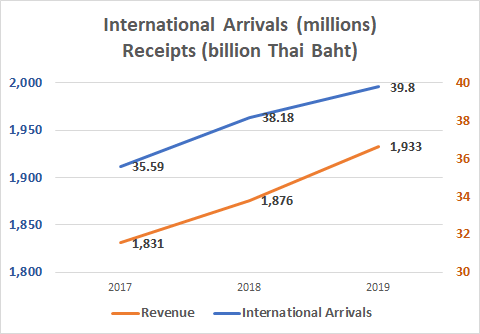
As noted above, the number of international arrivals increases year by year till 2019, bringing in lots of revenue. Averaged over three years from 2017 to 2019 (before Covid), the international traveler earned Thailand 49,661 Thai baht per person (let's say 50,000 baht).
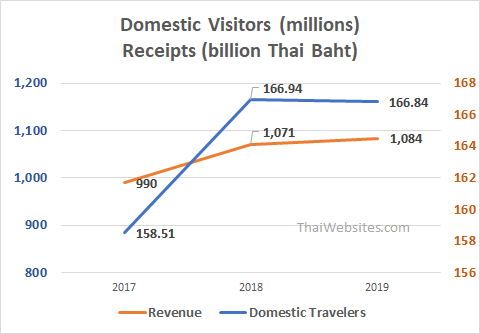
The number of domestic travelers is actually much higher, and reached almost 167 million in 2019. Averaged over the same three years, a domestic traveler spends 6.389 Thai baht on his trips.
When looking at the larger picture, it is obvious that domestic travel is a very important component. From 2017 to 2019, revenue from domestic travel amounted to 35.8 % of total revenue gained from tourism. Effects are underway to revive the Thai tourist industry, after the Covid-19 crisis, by encouraging domestic travel, and giving government sponsored promotions, however with only modest success.
Quarterly Arrivals from 2013 to 2023 :
(graph below shows quarterly arrivals from 2013 onwards only)Thailand has a tourist season when more visitors arrive. As you can see below, the number of visitors is almost consistently higher during the first quarter and the last quarter of each year. This coincides with a more pleasant climate in the country ('cold' season), and less favorable weather conditions in Europe, and large parts of Asia, like China and Japan.
From the graph you may see that the beginning of 2014 (political uncertainty) saw less than expected arrivals.
A military coup was staged and martial law was declared by the Royal Thai Army on 20 May 2014. The above contributed further to a decrease in travel arrivals during 2014, spread over the first three quarters of the year. During the first 9 months of 2014 around 2,000,000 less tourists arrived in Thailand, or a decrease of -10.28% when compared with the same period of 2013. But afterwards, the tourism industry had a very good period, with substantial increases in the number of arrivals. Military rule continued for 5 years, without further adverse effects on the tourism industry. The military government was followed by a 'civilian' government under the same prime minister in 2019.
The first quarter of 2020 saw a dramatic decrease in the number of visitors. This was totally linked to the emergence of the Covid-19 pandemic. A dramatic decrease to ZERO occurred in the second quarter and also in the third quarter of 2020. As mentioned, a very limited number of tourists arrived during the 4th quarter under stringent conditions.
As noted above, from the second quarter of 2020, till the third quarter of 2021 (this covers no less than 18 months), hardly any visitors came to Thailand. We estimate loss of income for the country at 75+ billion U.S. Dollar. It was decided (as in many other countries around the same time) to open for tourists again, still under stringent conditions, as of 1 November 2021.
As can be viewed below, there was a modest increase in visitors during the last quarter, especially during the month of December, which looks promising for 2022. Of the 427,869 visitors to Thailand in 2021, no less than 250,948 (58.6 %) came from Europe. Europeans may be simply dumber, less infomed, or more audacious, than people from other regions ?
The first quarter of 2022 saw further very modest improvement in the number of tourists arriving in Thailand. A total of 497,693 tourists arrived, the highest number since the first quarter of 2020, but still a far cry of the number of visitors in the years before (between 8 and 10 million visitors per quarter). The number of arrivals further improved to 1,582,257 in the second quarter of 2022. At least during the 3rd and 4th Quarter of 2022, we saw marked improvement in the arrival numbers, measuring 3.608 million visitors in the 3rd quarter, and 5.465 million visitors in the last quarter of 2022. The first quarter of 2023 saw 6,477,538 arrivals. Recovering of tourism to Thailand is on track. Possible negative factors : higher prices of airline flights, higher prices of hotels (promoted by some), poor air quality, especially in the North of Thailand, and in Bangkok, mostly in the period between December and April.
Interestingly, the second quarter usually has less visitors to Thailand than the first quarter. This trend is not clearly visible in 2023 , with visitors in the first quarter numbering 6,477,538 and in the second quarter slightly lower at 6,437,153. The third quarter saw a further modest increase in visitors to 7.09 million visitors, and in fourth quarter we passed the 8 million mark (8.095 million visitors).
.png)
Numbers show number of tourist arrivals per quarter of each year (in millions).
Source data : Department of Tourism, Thailand. Since a few years data are available at website of Ministry of Tourism and Sports.
P.S. : Wikipedia has a dedicated page covering the Covid-19 Pandemic in Thailand, which we surely can not improve upon.