
Buddha Image Iconography. Buddha Hand Gestures and Postures.
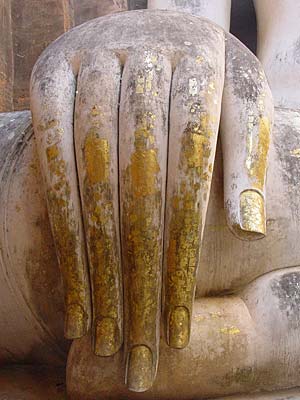
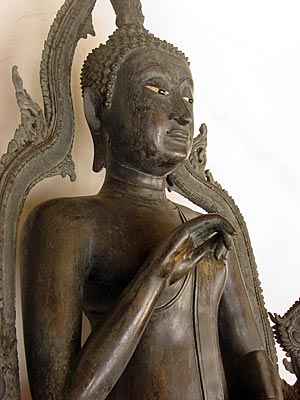
Detail of Hand, Phra Atchana, Wat Si Chum, Sukhothai Historical Park.
Posture of 'Subduing Mara' or 'Calling the Earth to witness'.
Although it reflects poorly on the speaker, it is not uncommon to hear the comment : "all these temples (or all these statues) look the same to me". The best way to remedy this easy boredom with historical and religious monuments is knowledge. Knowing what to look for and how to differentiate between different structures, will make for a much more interesting experience.
Buddha images were not made during the first few centuries after the life of Lord Buddha. They first appeared during the 1st and 2nd century A.D. in India. Almost immediately, a set of rules developed on how the Buddha should be depicted. It is worth remembering that a Buddha image is considered to be a hypostatis, endowed with supernatural powers and therefore has to be properly rendered. The Buddha is believed to have 32 major characteristics (and more minor ones).
Examples (that can be seen on Buddha sculptures) :
- The Buddha is flat footed
- Long en slender fingers and toes (often with the four fingers of both hands and the five toes of each foot of the same lenght)
- Between the eyebrows, a tuft of hair
- Head like a royal turban (or with a protuberance on top of the skull)
- No furrow between the shoulders
- Although not strictly listed at a major characteristic, Buddha images also have distended ear-lobes (from wearing heavy rings in early life)
- Etc.
The Buddha is always in one of four postures deemed suitable : Sitting, Standing, Walking or Reclining Postures. The dress of the Buddha is the monastic robe, draped over both shoulders, or with the right shoulder bare.
There are six major hand gestures of the Buddha (in Sanskrit : mudra)
Meditation (Dhyana Mudra) : The Buddha is usually shown in the Indian manner with straight body. The right leg is positioned above the left leg. Both hands lie flat in the lap, palms facing upward, with the right hand on top of the left hand.
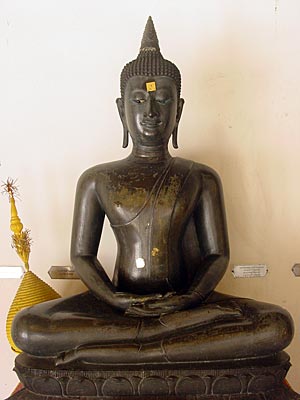
Buddha in Meditation Posture. Chiang Saen period, found at Chiang Saen. Presently at Wat Benchamabophit, Bangkok
Charity (Varada Mudra) : Gifts or favours are being granted or recieved. Usually on standing figures. The right arm is pendent with the open palm facing out and the finders pointing downwards in a straight line. [No example]
Absence of fear (Abhaya Mudra) : The right forearm is bent at a right angle with the palm of the hand facing out and the finders pointing upward. Often in standing position. Sometimes the gesture may be made with the left hand or with both hands.
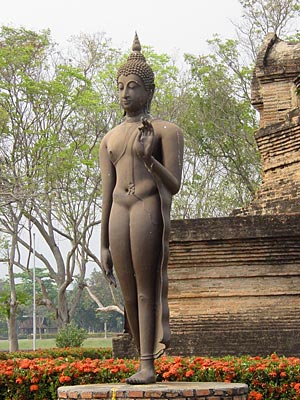
Walking Buddha, with the attitude of Dispelling Fear. Sukhothai Historical Park, Wat Sa Sri
Reasoning, Giving Instruction (Vitarka Mudra) : The right forearm is bent, often somewhat closer to the chest than in Abhaya Mudra. Three fingers of the hand are bent upwards, the thumb and the forefinger touching. Sometimes the left arm, or both arms are used for the same gesture.
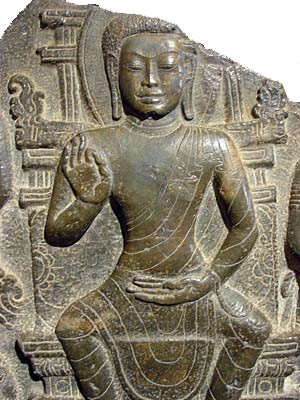
Stone carving of scene from the Buddha's life. Dvaravati art 7th-11th century A.D. The Lord Buddha is seated in so-called 'European' fashion. Hand gesture of Giving Instruction, Teaching. Phra Pathom Chedi National Museum (Nakhon Pathom) Original found at Wat Sai, Nakhon Pathom
Setting the Wheel of the Law in Motion (Dharmacakra Mudra) : This symbolizes the first sermon preached at the deer park in Sarnath. Both hands are together in front of the chest, each hand held in the same position as in the Vitarka Mudra, but with the ends of the fingers of the left hand against the palm of the right hand.
(often the distinction between Vitarka Mudra and Dharmacakra Mudra is somewhat unclear)[No example]
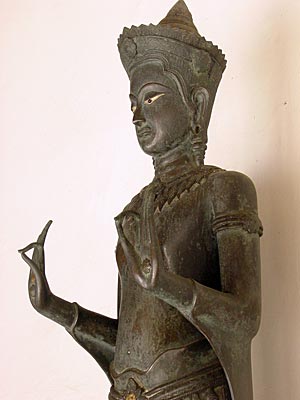
Buddha with the posture of Giving Instruction, Teaching (both hands). Lopburi period, image cast and enlarged from an ancient model. Presently at Wat Benchamabophit, Bangkok
Subduing Mara (calling the Earth to witness ; Bhumisparsa Mudra). Only in sitting position. The position is similar to the meditation position. The left hand remains in the lap. The right hand is resting on the thigh near the knee, palm inward, and fingers touching the ground slightly. This posture of the Buddha is the most common to be seen in Thailand.
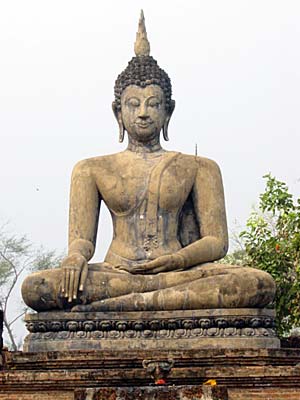
Buddha image with the posture of Calling the Earth to witness (or 'Subduing Mara') Wat Mahathat, Sukothai
While the above represent the most common gestures to be seen in Buddha images, many more exist. For instance, during the early Rattanakosin period in Thailand, a list of 40 standardized poses was compiled. However, except at few locations, one will not see these 'secondary' poses.
In Thailand, there are also postures and gestures of the Buddha, associated with each day of the week (actually eight in total, including two for wednesdays).
Some more examples of Buddha postures :
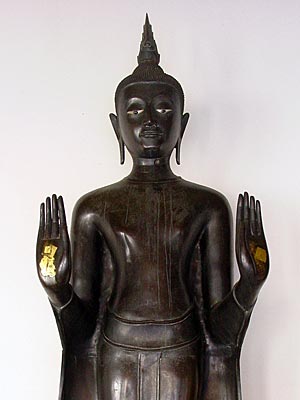
Buddha image with the posture of 'Calming the Ocean'. Ayutthaya style, found in Petchaburi.
Presently at Wat Benchamabophit, Bangkok
Sitting Buddha image, with the gesture of 'Invoking Victory'. Ayutthaya period, enlarged from an ancient model.
Presently at Wat Benchamabophit, Bangkok
Inspirational Source : Gestures of the Buddha, by K.I. Matics. Chulalongkorn University Press.
Buddha images in different styles can be found at :
Wat Benchamabophit, Bangkok
Phra Pathom Chedi, Nakhon Pathom
Many more Buddha Images at : www.buddha-images.com