
Asbestos in Thailand
When you move to a foreign country, it may take a while before you 'know it all' and see the differences between your new environment and the one in your home country.
Asbestos use in Thailand may be one of the unexpected surprises you encounter.
Personally, I was under the impression that asbestos was a banned substance, and where I come from, quite some money has and is being spent on removing it from older buildings.
In Thailand, as of now, at least one form of asbestor, chrysotile is still widely used.
This came to our attention at least since 2006. An article in the Nation newspaper at the time revealed important facts. While chrysotile has been outlawed in (most) Western countries, Thailand (like Malaysia, the Phillipines and China) continues to use it in construction. Apparently it strenghtens construction, and is cheaper than substitute products that are presently available.
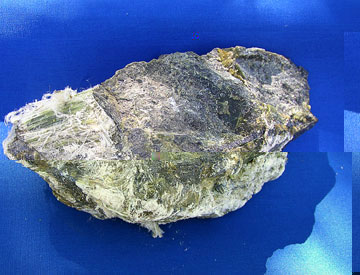
Piece of chrysotile asbestos. Source : Wikipedia
The toxicity and carcinogenicity of chrysotile, when compared to other forms of asbestos, is certainly a complicated matter of research. However, we take this quote from the Wikipedia article about asbestos :
''Chrysotile has been included with other forms of asbestos, in being considered to be a human carcinogen by the International Agency for Research on Cancer (IARC) and by the U.S. Department of Health and Human Services .''
Importantly, the World Health Organization (WHO) produced a separate report on the use of chrysotile asbestos in 2014, likely because some countries still single out this product as being safe or safer, than other forms of asbestos.
It summarizes evaluations performed by its
International Agency for Research on Cancer (IARC) and its International Programme
on Chemical Safety (IPCS). In its conclusion, it states that all types of asbestos (including chrysotile)
cause asbestosis, mesothelioma and cancer of the lung, larynx and ovary.
You can find extensive information in PDF file here, sorry if this link proves not permanent. The file also list a large number of alternatives for asbestos use.
Concise information about asbestos can be found on the WebMD.com website . It does state that chrysotile, though harmful, may be less so than the other (less uses) form of asbestos, amphibole asbestos.
So, whether you stay in Thailand for a holiday in a hotel, or reside here in a condominium, it is quite possible that the building you are in contains chrysotile, a form of asbestos. Probably not necessary to panic, but maybe you should not drill too many holes in your walls, and let the stuff escape into the air you breath.
Asbestos use at present in Thailand :
While the World Health Organization also supports a ban on asbestos use, the mineral is still legally imported and used by Thai builders. Thailand apparently imports an astounding amount of chrysotile asbestos, no less than 100,000 tonnes a year. It mainly goes into roof tiles and cement pipes, but also into brakes and clutches, vinyl floor tiles, and heat insulating materials. Using asbestos instead of other materials such as polyvinyl alcohol for roof tiles, saves a few thousand baht in overall construction costs.
A first case of mesothelioma was diagnosed in 2008 in Thailand in a elderly man who had worked in the roofing tile business. Cancers related to asbestos, occur a few decades after exposure, so it is possible that more will be detected in the coming years.
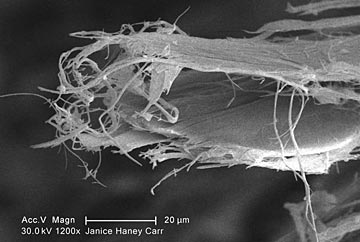
High magnification by scanning electron micrography (SEM) of piece of Chrysotile Asbestos.
Source : Wikipedia
2009-2010
The Thai Consumer Protection Board manages to require labelling of products containing asbestos (2009). In 2010, warnings that exposure may lead to cancer, had to be included.
2011
According to an article in 'The Nation' dd. 21 Januari, the National Economic and Social Advisory Council (NESAC) and the Health Assembly studied the impact of the use of asbestos (chrysotile) in Thailand, and proposed to the Industry Ministry to halt the use of this mineral in roof tiles.
There are four important roof tiles manufacturers in Thailand. Only one of them, SCG, a part of Siam Cement Group, has abondoned asbestos as part of its manufacturing process in Thailand (and saw its share in the market go down, due to higher prices for its products). Presently, the remaining three companies import 69,000 tonnes of asbestos into Thailand each year. A marketing manager for Oran Vanich, one of the roof tile makers, stated that chrysotile made for cheaper and stronger roof tiles (compared to when substitutes are used) and that there was no proof that mesothelioma cases in Thailand had been caused by asbestos. A director at Chulalongkorn University however stated that proof that chrysotile is a dangerous substance was available in other countries, and that Thailand did not need to wait to change its present policies (and ban asbestos).
2012
For sure, Asbestos is not a major topic of conversation, but articles about the continued use of it, turn up once or twice a year in the printed media in Thailand.
The Public Health Ministry and non-governmental organizations have proposed a ban on the use of asbestos. While the government seems to think about this issue for a while now, it has yet to implement laws related to a ban on chrysotile asbestos use.
The latest outcry (October 2012) comes from what is called in the Bangkok Post, the Swine Industry (?). According to the Swine Raisers Association of Thailand, a ban would cost the swine industry up to 4 billion U.S. Dollars. Chrysotile (white asbestos) is used in roofing tiles that are used (besides in other buildings) in livestock sheds. These tiles would have to be replaced at great expense.
2013
(Bangkok Post article April 2013)
It became apparent that chrysotile asbestos, used in Thailand, is important from Russia, with an annual value of around 30 million US$. Trade representatives and the vice-president of the Thai-Russian Chamber of Commerce, are quoted promoting the substance, and putting down the suggestion that asbestos is hazardous to human health.
2014
End 2014 the issue was reviewed again in an interesting article published in the Spectrum supplement of the Bangkok Post.
We found the striking statistic that more than 17 million houses (!) in Thailand use roof tiles containing asbestos. Removing those and replacing the tiles would cost a staggering 450 billion baht.
Conclusion :
Is this a simple issue of development? Asbestos, including white asbestos or chrysotile has been banned for use in most industrialized, developed countries. The goverment of Thailand (Public Health Ministry) wants to move the position of the country regarding asbestos in line with what has happened in Western countries. Part of Thai Industry wants to stay put, and keep on using the substance because it is cheaper.
While replacing old tiles and construction materials containing asbestos, costs a lot of money, it will of course turn out to be a major business opportunity for producers of tiles (most of whom are now complaining about the higher production costs of asbestos-free materials).